Perhaps it is a bit extreme to say “Paths make the garden,” but ever since I was a child paths have been an emotionally significant element to my enjoyment of a garden. I didn’t realize this until we moved to the rural 15 acres where we now live, when I struggled with how to turn acreage into a garden.
That a path exists gives a sense of safety. You know you won’t get lost or swallowed up as long as you can see the path. The fact that you can’t see where a path leads is what lends it the air of mystery, what gives you a little tingle of excitement.
Once I realized that paths were called for, the problem became one of creating and maintaining them. (I still feel abysmally ignorant about this subject, so if anyone knows of a book on trail maintenance, please let me know.)
The entrance to the Secret Garden
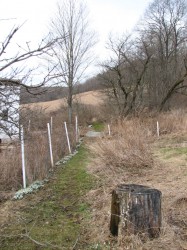
The snowdrops entice me outdoors (click for larger photo)

The snowdrops entice me outdoors (click for larger photo)
As you walk up our driveway, the most obvious path is to continue straight uphill, past the vegetable garden, through the field, and up into the woods. I prefer to turn left shortly after leaving the driveway, and walk down the entrance to what I call the Secret Garden. After threading through the Secret Garden, the path will go uphill, sandwiched between the property line and a trickling brook. Eventually it will turn right to join the main path, which continues to climb even as it circles around, finally going downhill to rejoin itself.
Here are five seasonal views of that entrance. In March, the snowdrops are reason enough to venture out of a warm house into the chilly air.

Poet’s narcissus line the path in May
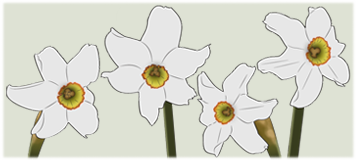
In May, poet’s narcissus (Narcissus poeticus) nod to me as I pass by. If I’m lucky, the apple trees will be blooming at the same time. May is also the time of year to search for native spring ephemerals. It’s a magical time of year.

In June, the same path is cloaked in green
As the narcissus fade away, the wild cranesbills (Geranium maculatum) take their place in early June (above), superseded by goldenrod and asters starting to bud in mid-August (below).
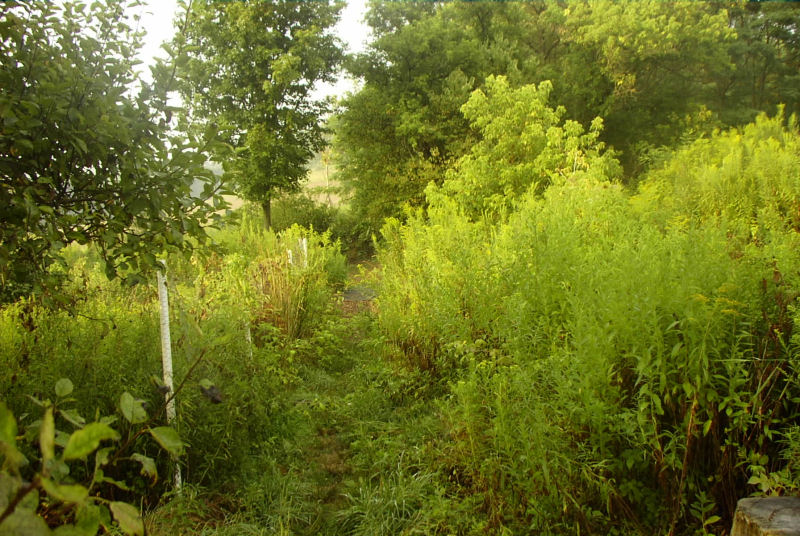
Overgrown in August

The same path in October, from a slightly different angle, and a different year.
In October, the brilliant foliage and blue skies beckon, and the prospect of seeing the witch hazels (Hamamelis virginiana) in bloom convinces me to bundle up against the brisk breeze and take to the trail.
Design Challenges for Woodland Paths
In her second post on pathways for the Garden Bloggers’ Design Workshop, Fran asked, “If someone waved a wand and told you that you could re-create your garden paths regardless of the price, what would you do?” Looking ahead to my declining years, I’d like to improve the footing along the path. This would include
- A stairway cut into the steepest hill
- Bridges where the path crosses the stream and boardwalks over the wettest portions
- Replace the bench that’s rotted; figure out suitable spots for more seating
- Remove rocks and bury protruding roots to eliminate tripping hazards
Of course I hope to always have enough health and strength to make it all the way up the hill and back. I’ll ignore the fact that many of my children run up and back.



Mr. McGregor’s Daughter, some of my other posts which I linked to from this one go into more detail about the maintenance. We use a walk behind brush mower to maintain the trails. (We meaning older teens/menfolk.) I try to remember to take my pruners whenever I walk the trails, and clip branches or brambles that are growing into the pathways.
We have had goats in the past, but they aren’t suitable for trail maintenance per se, though they will clear all the undergrowth from a fenced in area. And if you don’t move them to a new area immediately, they will start on the tender twigs and bark of everything in reach. I know from personal experience that they love lilacs and apple trees.
I like how the feeling of the path changes with the seasons. I can’t imagine trying to maintain a path that long. Goats? Cows?
I guess my former comment was referring to impact rather than design, by keeping developed garden/flower plantings in one group thereby leaving a small as possible footprint on your landscape. Preserving (do not alter) all natural features such as streams and wetland buffer areas, woods, etc. which are sensitive and valuable environments…significantly important conservation areas. Avoiding disturbance of grasslands, slopes, trees, etc. and subsequent impacts to the soil. There is great value in maintaining all natural landscape remnants, not to mention great beauty. The ‘design’ goal of your path should be to leave as little trace as possible from starting point to final destination. You are fortunate to be the proud keepers of such a beautiful space.
No matter how long or arduous the walking may be, when you follow your paths, Kathy – you know there will be something to look at on your country property. For those of us on urban quarter acres… the path usually leads to the trash cans or junk stashed behind the shed.
Annie at the Transplantable Rose
I confess, Carol, I’ve never actually measured it. But our land goes uphill almost half a mile, and counting all the side loops, it must surely double itself. So, okay, it may not be exactly a mile, but it’s pretty close. One day I’d like to accurately plot it out as a map.
A path that goes for a mile? I could only dream of something like that in my suburban lot. I clearly need more land, if wishes were fishes (or horses). I can see that your trail would be enticing in any season, even winter.
Thanks for pointing me to the book, Nan. Most of my proposed improvements are of the “if wishes were horses” variety. It is a pleasure in every season, though I only showed but a fraction of its more than mile-long length.
I can understand why you’d want to improve some of the safety aspects of the path, Kathy, because I too deal with ground-level perils such as rocks, stumps, and groundhog holes in my meadow paths. But from a purely aesthetic aspect, I’d say your path is absolutely enticing as it is, as much in its “overgrown” state as in its spring tidiness. As far as books on trail maintenance go, you might want to check out The Complete Guide to Trail Building and Maintenance by Carl Demrow and David Salisbury, published by Appalachian Mountain Club Books in 1998. I bought it for my dad a few years back and got to flip through it briefly before wrapping it; some parts are relevant mostly to public trails, but I thought it had some useful ideas for home-scale properties as well–particularly about handling slopes and steps and dealing with erosion problems.