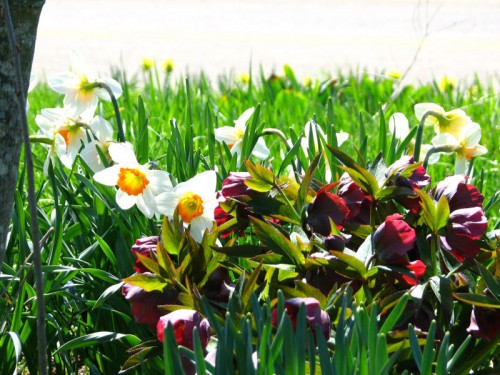
 This looked spectacular earlier in May, but the narcissus were already done by the time Gardeners Bloom Day came around.
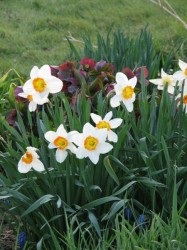 Those orange-cup daffodils were blooming at my neighbor’s, between her house and the brook, but too far away from the house to be noticed. I marked them and dug them up and got half for myself for the labor of digging and replanting her half. The hellebore came from Seneca Hill Perennials. I didn’t plan this combination. The daffodils were already there; the hellebore was an unexpected gift that I had to “put somewhere,” and that’s where I thought the hellebore would be happy.
I’ve since surrounded these two with some grape hyacinths that bloomed somewhat after the peak of these two, and there weren’t enough of them to make an impact this year.
What do you think?
Tagged as:
daffodils,
hellebores,
Narcissus,
plant-combinations
About the Author

Kathy Purdy is a colchicum evangelist, converting unsuspecting gardeners into colchicophiles. She gardens in rural upstate NY, which used to be USDA Hardiness Zone 4 but is now Zone 5. Kathy’s been writing since 4th grade, gardening since high school, and blogging since 2002. Find her on Instagram as kopurdy.
Now, the digging and dividing of perennials, the general autumn cleanup and the planting of spring bulbs are all an act of faith. One carries on before the altar of delayed gratification, until the ground freezes and you can’t do any more other than refill the bird feeder and gaze through the window, waiting for the snow. . . . Meanwhile, it helps to think of yourself as a pear tree or a tulip. You will blossom spectacularly in the spring, but only after the required period of chilling.
~Adrian Higgins
in
The Washington Post, November 6, 2013
 This looked spectacular earlier in May, but the narcissus were already done by the time Gardeners Bloom Day came around.
 Those orange-cup daffodils were blooming at my neighbor’s, between her house and the brook, but too far away from the house to be noticed. I marked them and dug them up and got half for myself for the labor of digging and replanting her half. The hellebore came from Seneca Hill Perennials. I didn’t plan this combination. The daffodils were already there; the hellebore was an unexpected gift that I had to “put somewhere,” and that’s where I thought the hellebore would be happy.


Wow! I love that combination, Kathy! It is spectacular! (i’m one for lots of contrast~)
Bergenia sounds like another good choice, but I am not sure if it is evergreen in my climate. Not that it matters too much if it’s buried in snow, which is the usual case in winter.
I like your combination, Kathy. If anything, I’d add something like Bergenia Cordifolia , an evergreen with bold leaves and a nice pink flower.
What do I think? I think that your combination is wonderful. I would add Bergenia, which has bold evergreen foilage and a great stalk of pink flowers.
Kim–my first response, only half-joking, was: weeds. But actually, just beyond the narcissus are some daylilies. The daylilies were there first, and I can’t remember now if they coordinate with the hellebore foliage or not. The hellebore blossoms are history by the time the daylily blooms.
Ted–I’ve got enough ajuga other places, but I really like your idea of a purple-leafed heuchera of some sort. Do you know of any that have spectacular foliage and prominent flowers, like ‘Raspberry Regal’ does?
Purple and orange are always a great combination. How about adding a little purple foliage – ajuga, heuchera or the like?
I like it a lot, Kathy–especially backlit like it is in the first picture. The deep rose of the hellebore adds some nice warmth to the whole scene. What do you put around the hellebore once the daffs die off?
I have no problem being added to a person’s blogroll unless they are selling illegal or pornographic material, or if they are a spam farm of some type. For everyone else, I take it that you are recommending me to your friends. It’s quite the compliment.
I’d like to add your site to my blogroll, I hope you don’t mind.