Entries tagged with native-plants
In 1878, Sherman Stowell sold to Elizabeth Brockett 30 acres of land which he had earlier purchased from George Jennings. I now live and garden with my family on some of that land, which Jennings or Stowell, or perhaps Ms. Brockett, had cleared of trees to make pasture. The forest is growing back, but it’s not the same forest. For one thing, several invasive plants are now growing here, everything from Rosa multiflora to Lonicera tartarica. And where are the trilliums?
Call me a romantic or call me ecologically correct, but I’d like to restore the native flora to my parcel of land, land that was sown to timothy and grazed by cows. How does one go about such a restoration? For starters, you have to know what plants were originally growing there. I’ve taken an informal survey of our property and catalogued all the natives I’ve found. I mention trilliums because they bloom along the roadside further down our country lane. What will it take to grow them here?
Popularity: 20% [?]
Tags: allan_armitage· central-NY· cny· donald_leopold· houghton_mifflin· native-plants· timber_press· upstate_ny· william_cullina
I’m not sure what’s going on here, whether it’s some kind of mutation or a result of weather or other kind of damage. On the right is a typical Virginia bluebell (Mertensia virginica). It has the typical salverform blossom, and 5 sepals in its calyx (the part that is circled).
Popularity: 29% [?]
Tags: anomalies· Mertensia· native-plants· tetraploidy· Virginia_bluebells
Yes, I know the Garden Bloggers Bloom Day was yesterday the day before yesterday. I didn’t get finished in time. So just pretend this is May 15th, okay? (As always, hover your mouse over any thumbnail for a caption, and click on any photo for a larger image.)
Narcissus
Let’s start off with the narcissus. The early daffodils are all gone, but the later ones are in their prime. Do you remember those new ones I told you about? Let’s start with them.


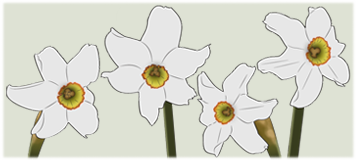
Left to right, the most recently opened first: Malin Head, Achnasheen, Rimmon, Eland, and (second row) Vernal Prince. Angel doesn’t look like it will bloom, as Mr. Burdick suspected. It’s been a cool spring–until today, when it got up to 88F–and many of my daffodils have remained good looking for a long time. Here’s more that are blooming right now:
Popularity: 41% [?]
Tags: Acquisitions· anemone· bloom_dates· bloom_records· caltha· daffodils· ell· gaywings· marsh_marigold· May· meadow_rue· Mertensia· Narcissus· native-plants· polygala· secret_garden· thalictrum· trilliums· violets· Virginia_bluebells· wood_anemone
I spent my childhood in climates where the flowering dogwood (Cornus florida) flourished, and I loved its elegant simplicity. When we moved here, I was dismayed but not surprised when my new neighbor told me that she had twice planted a flowering dogwood in a protected corner of her house, and twice it had died. Having just endured my first thirty-degrees-below-zero-Fahrenheit winter, no, I was not surprised.
Popularity: 25% [?]
Tags: amelanchier· Juneberry· native-plants· northern-gardening· spring· trees
February 17th, 2007 · 1 Comment
Brave the snow, get out of the house, and learn something new! Here are some gardener-worthy events coming up in my neck of the woods.
“CNY Blooms” –Spring 2007 will sprout up before you know it, and with it the blossoming of Syracuse’s flower and garden show, now known as “CNY Blooms”. Mark your planting calendar and get ready to enjoy this beautiful show, devoted exclusively to the world of flowers and gardening. It all starts blooming March 1st through the 4th, 2007, in the Convention Center at Oncenter, Syracuse. Hundreds of area landscapers and horticulturalists will be offering you the best of the season’s blooms. Interested in learning more about perennial flower gardens? Want to know more about creative outdoor structures or innovative patio designs? There will be seminars and presentations to help with your landscape plans. Adults-$9, Children 12 and under free. Discount coupons available at a Price Chopper store near you
Popularity: 35% [?]
Tags: central-NY· cny· flower-show· garden-design· garden-events· Habitat gardening· Ithaca· native-plants· Syracuse
Sunday, October 8th, was a gorgeous autumn day, sunny and warm. I decided to go up the hill for a walk in the woods, camera in hand, and you get to share the results. (Be forewarned: this is an even longer than usual post.) But first, a little bit about where we’re going. Our family lives on 14 acres. It is a narrow slice of hillside, with our house near the road at the bottom of the hill and our land going uphill for about half a mile. Once upon a time, it was all forest. We figure our house was built sometime in the 1880s, so that’s probably about the time the trees were cleared for pasture, though it’s always been marginal land for grazing: not especially fertile acid clay, with a high water table that leaves many areas soggy during years of average rainfall. The forest has been growing back as the occupant before us (and maybe the one before him) gradually stopped mowing the areas furthest away from the house, though we still have a field of about 4 to 5 acres.
The field gets mowed yearly with a brush mower, which is also used to keep paths through the woods cleared enough so a suburban girl like me can pick her way without carrying a machete or getting lost. The path starts out in what I call the Secret Garden, which is an area closer to the house that reverted to trees early because it’s clearly too wet to mow. I have dreams of turning it into a native plant garden, but for now, that’s mostly all it is, an idea that, maybe someday . . . After meandering through the Secret Garden, the path starts going up, and threads through the hedgerow alongside the field before joining the woods proper.

Don’t these berries look ornamental? And the birds love them. Such is the recipe for disaster, for these are rose hips of the invasive Rosa multiflora. This shrub is growing on the bank of the seasonal brook that borders the northern side of our property, right before it narrows and becomes easy to cross at the top of a hill. As you cross the brook at this point, you can look back down the slope and watch the water spill over the rocks. I used to dream of sitting on a bridge and enjoying the view, which I would enhance with ferns and native flowers planted into the steep bank. But it took a mere decade for this little glen to fill up with the thorn-infested brambles, which I’ll have to remove before I can ever realize my dream, and I’ll have to be eternally vigilant ever after. Don of An Iowa Garden has been working on eradicating this shrub, and it sounds exhausting.
Popularity: 50% [?]
Tags: asters· autumn· colchicum· Colchicums· foliage· Habitat gardening· native-plants· paths· secret_garden· winterberry· witch_hazel
September 16th, 2006 · 13 Comments

Isn’t this a stunning specimen of Polygonum cuspidatum? The generous rainfall we’ve had this season has brought it into top form. Too bad it’s on America’s Most Wanted list. Yes, this is Japanese knotweed, aka Japanese bamboo, Mexican bamboo, fleeceflower, and Fallopia japonica. (I’ve been told that it’s also known as privy weed, but I couldn’t find any confirmation of this on the web. However, the luxurious stand pictured above is growing right where I was told the outhouse was located, back in the days when our house lacked indoor plumbing. Presumably the leaves were used as a makeshift toilet paper.) And all this luxuriant vegetation will be knocked down by the first frost, only to rise again next spring. Vigorous scarcely begins to describe this ambitious plant. It is invasive. It is beautiful. Who said villains are always ugly? And if you like to play with fire, Plant Delights Nursery sells three Polygonum cuspidatums that they claim do not spread by rhizomes. Two of them are variegated, and they are wow! plants. But will I buy one? Let’s just say, “once burned, twice shy.”
A lot of the weeds are looking really good.
Popularity: 28% [?]
Tags: impatiens· invasive_plants· japanese_bamboo· japanese_knotweed· jewelweed· native-plants· polygonum· weeds